
Diamond grinding segments may look similar at first glance, but their performance can vary considerably depending on how they are designed. A diamond segment with a bond that is too soft may wear excessively when used on soft, abrasive concrete. On the other hand, a segment with a bond that is too hard may struggle to expose fresh diamonds when grinding hard concrete, resulting in reduced cutting efficiency. This is why diamond grinding segments are developed in different configurations rather than made to suit every floor condition. Their design needs to reflect the material being ground, the amount of material to be removed, and the surface finish required at each stage of the job.
Bond hardness is one of the main considerations. The metal bond holds the diamond particles in place and gradually wears away to expose new cutting edges. On soft or highly abrasive concrete, a harder bond is generally preferred because it slows down bond wear and helps extend tool life. Hard concrete usually calls for a softer bond, allowing the matrix to wear more readily and expose fresh diamonds instead of becoming glazed. This principle is central to the development of metal diamond grinding tools, although aggregate type, concrete condition, machine weight, and actual grinding behavior also influence which bond performs best.
Diamond grit size and segment geometry are selected according to the grinding stage and the condition of the floor. Coarser grits are commonly used for more aggressive material removal, leveling, and initial grinding, while finer grits help produce a more refined scratch pattern before the floor moves to subsequent honing or polishing stages. Segment shape, size, and arrangement also affect how the tool contacts the surface and how evenly it grinds. For example, a segment configuration designed for aggressive stock removal may not be the best choice when the priority is controlled grinding and a more consistent surface. These considerations are particularly relevant when selecting diamond grinding tooling, where floor hardness and the intended grinding result can vary from one project to another.
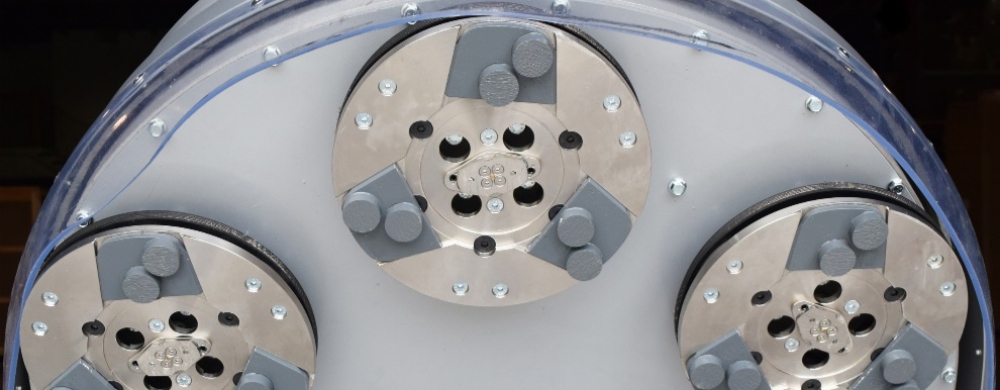
Different floor applications also place different demands on the tooling. On concrete floors, diamond segments are widely used for removing surface irregularities, exposing aggregate, and preparing the substrate for polishing or a new coating. Terrazzo requires more attention to its binder and aggregate composition, since cementitious and epoxy terrazzo can respond differently during grinding. Coating removal is another distinct application: thick or stubborn epoxy and adhesive layers often require purpose-designed PCD coating removal tools for bulk removal rather than conventional metal bond segments. Once the coating has been removed, suitable diamond grinding segments can be used to refine the exposed concrete as needed.
Tool design also needs to be evaluated through actual grinding performance. A segment may show good cutting ability during initial testing, but its performance over a longer working period is equally important. Manufacturers need to examine how consistently the diamonds are exposed, whether the bond wears at a suitable rate, and how the segment affects the scratch pattern on the floor. These observations help identify areas where the bond formulation, diamond grit, or segment geometry may need adjustment. For contractors, selecting TransGrind professional diamond tools that suits the floor material and the intended grinding stage can make a noticeable difference in both tool performance and the consistency of the finished surface.

 IPv6 rede suportada
 English
 français
 Deutsch
 русский
 italiano
 español
 português
 العربية
 日本語
 Polski
 中文